Hi my zoulous and welcome to this new video. In this video, we’re going to talk about creating a deck in Spellcaster Chronicle.
Choosing Your Hero
First of all, before talking about the deck, we need to choose a hero. Why? Because heroes have passives and skills that can influence the creation of your deck.
For example, the Stone Shaman has reduced cooldowns for skills from the Wild Incantation magic school (Wild Magic in English). So we will at least partially focus on spells from that type.
Let’s take a second example with the Iron Sorcerer. He has the passive War Scourge, which increases Tier 3 population and reduces Tier 2 population. It will therefore be interesting to pick Tier 3 units and probably fewer Tier 2 units.
Creating a Build
Once you’ve chosen your hero and fully understood their passives, we can move on to creating a build.
General Rules
Important rule: you must have at least 1 Tier 1 or Tier 2 unit in your deck. Why? Simply because when you start a match, you only have access to Tier 1 and Tier 2 skills. Without one of them, you wouldn’t be able to capture bases.
You will unlock Tier 3 spells and units at level 5, and Tier 4 at level 10. You also need to pay attention to the population system when creating your deck. Each unit tier has a maximum population, which increases as you level up. For example, with the Stone Shaman, from level 0 to 4 you can have up to 15 T1, 10 T2, 3 T3, and 1 T4.
When you reach level 5 up to level 9, T1 population increases by 10 and T2 by 5, etc.
You can pick multiple units of the same tier, but you should avoid taking, for example, four T3 units since you’ll be limited by population anyway.
Next, you need to define your deck’s objective. Do you want an offensive deck with many units? A defensive one with buildings that generate units and others that protect them? Maybe an anti-hero build or one specialized against large units? The possibilities are numerous, and many builds are viable even if they are completely opposite in playstyle.
Build Example
Let’s create an example build with the Stone Shaman.
Skills
First, let’s look at the skills.
1st skill: Mountaineer’s Staff. If you hit a building multiple times, this skill enchants it, creating a healing zone around it.
Buildings can be base towers, ballistas, walls, summoning buildings, etc.
So it could be interesting to include at least one building in your deck.
Second skill: Kamazad Wall.
This skill can combo with the first one and slow down enemy advances. Other than that, it doesn’t specifically impact your build.
3rd skill: Wind Shield. This shield blocks projectiles and deals damage. As it stands, it doesn’t directly influence your build either.
Passives
Now let’s move on to the hero’s passives.
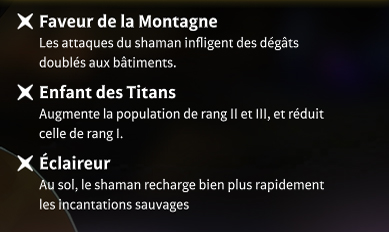
Mountain’s Favor increases damage dealt to buildings. Keep that in mind for later.
Next, Children of the Titans increases Tier 2 and Tier 3 population while reducing Tier 1 population.
Again, keep this in mind when selecting the units for your deck.
Final passive: the Shaman recharges Wild Incantations faster. As mentioned earlier, Wild Incantations are a magic school containing various skills. You can access them in the Magic School tab.
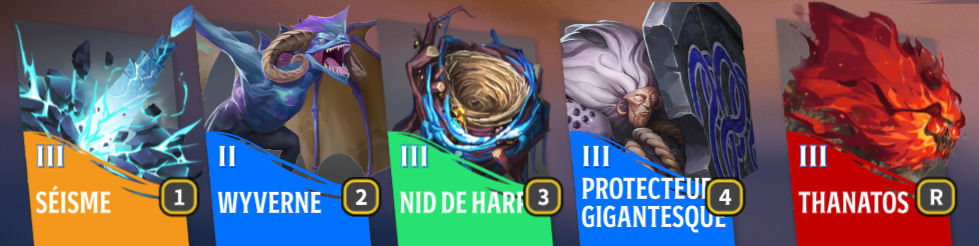
Now we’ll use everything we’ve noted. Let’s start with the Harpy Nest. It’s a Wild Incantation, so it benefits from faster cooldown. It’s also a building, meaning we can create a healing zone around it to hold a point more easily. As for the harpies themselves, they are flying T1 units that deal good damage to ground units. Keep that in mind.
Optimization
We also have the Wyvern, another flying unit that attacks from range. Remember, the Shaman benefits from increased T2 population, so the Wyvern is worth considering.
At this point, we can already identify a weakness.
Since the build currently consists only of flying units, anti-air units like Lizard Archers could become a problem.
Adding Sirens, who can control enemy monsters, is quite situational and won’t really fix the issue.
Maybe we should look at summons that are not Wild Incantations. Remember, we have a population bonus on T3 units.
Let’s see what’s available. The Steam Tank is potentially interesting but is also ranged. We’re looking for something that can frontline, since currently our only melee option is the T1 harpies.
The same issue applies to the Stone Behemoth, although it can frontline somewhat.
The Ogre is a fairly tanky unit that can help assault towers. Why not, but let’s keep exploring.
Last available T3 unit: the Gigantic Protector.
This unit is excellent for frontline because it’s tanky and blocks projectiles with its shield — very useful to protect our flying units. We’ll choose this one.
Now we have one last slot remaining.
Weakness Analysis
Before deciding, let’s look at the threats our current build might face.
- Handling large monsters or titans is very difficult. We have the hero’s wall to stall, but our overall DPS is limited, which could cause problems.
- Our hero has no ranged attack, making it hard to kill enemy heroes. We’ll likely adopt a defensive posture.
- It may also be difficult to deal with building-focused builds.
- Finally, the build is rather weak in early game since we only have one T2 unit to start (harpies from the nest are only available at level 5).
Possible Solutions
Here, you have several options depending on your preference. For example, you could add Astral Nova to better handle large monsters.
You could also lean into passives with something like Raging Frost to partially freeze enemies and empower your units.
Or you could choose Earthquake, which makes it much easier to deal with building-based builds, synergizing with your hero’s double damage to buildings and faster Wild Incantation cooldowns.
Personally, I decided to pick Earthquake to have a stronger impact against buildings.
Titan Choice
As for the titan, you have Gaia, who has better stats, or Thanatos, who has slightly lower stats but reduces enemy movement speed and increases the damage they take.
Personally, I chose Thanatos for the movement reduction since I’m playing more defensively and will let my allies push while I slow enemies as much as possible.
Conclusion
And there you go — a new build to test! Of course, these choices were made based on the information available and my personal experience, but this build isn’t necessarily THE best solution. Nothing beats testing your builds against the current meta and adapting them based on your own experience.
Additionally, this build was designed for solo play. If you’re playing in a group of three, for example, it could be interesting to have one anti-large titan/T3–T4 build, one push-oriented build, and one defensive build.
That’s what makes the game so interesting — it allows many builds and counter-builds, leading to matches that are always somewhat different, where adaptation matters more than simply playing the strongest meta build.