Types of resources
First of all, there are 2 types of resources.
Resources stored in your inventory, which are mainly useful for your character, and resources stored in your wagon, which allow you to manage troop maintenance among other things.
Let’s start by looking at the resources stored in your wagon and more specifically how to obtain them.
Methods for obtaining wagon resources
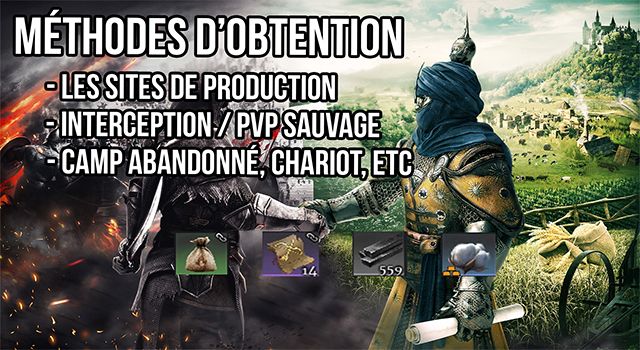
Production sites
The first method is simple: go directly to production sites.
To do this, you must go to the world map by talking to the watcher at the exit of cities. Once outside, open your map by pressing the comma key, and search for the production site(s) you are interested in.
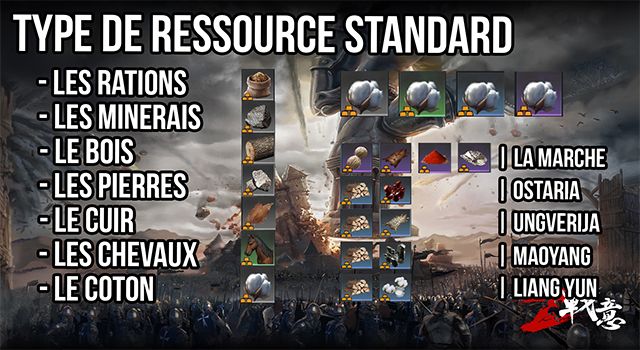
You should know that there are 7 types of standard resources, which are:
- Rations (produced by farms) used to supply troops.
- Ores, logically produced by mines
- Wood produced by sawmills
- Stone produced by quarries
- Leather produced by tanneries
- Horses produced by pastures / paddocks / etc.
- And cotton produced by cotton fields
In addition, there are different tiers for each type of resource, which are:
- Grey (for Common resources)
- Green (for Decent resources)
- Blue (for Rare resources)
- Purple (for Epic resources)
In addition to the 7 standard resource types, there is also the concept of exotic resources. Each time you harvest, you have a chance to obtain the exotic resources indicated at the harvesting location.
Additional information: some exotic resources can only be found in specific territories.
For example:
- Mountain cotton, wolf fur, phosphorus, and bauxite, which can only be found in the Marche territory
- Yew wood and minium in Ostaria
- Yew wood and bison hide in Ungverija
- Larch wood and tungsten in MaoYang
- And finally larch wood and cloud cotton in the Liang Yun territory
Of course, the higher the level of your units, the higher-level resources you will need to maintain their equipment.
Important information: when you collect resources from a production site, you must first pay a fixed fee that depends on the rarity of the resource, plus a tax that depends on the house that owns the production site. We will discuss this in more detail in a future tutorial.
If you do not use requisition orders, the number of times you can collect resources per day is limited.
So we have:
- 0 harvests if the house is an enemy and has prevented you from accessing its resource
- 1 harvest if the house has authorized you to harvest but you are not allied with it
- 2 harvests if the house that owns the territory is an ally
- And 3 harvests if the production site is part of your house’s territory.
You should also know that you can bypass taxes and territorial restrictions by using requisition orders.
Open-world PvP
Let’s move on to the second method of obtaining wagon resources, which is open-world PvP or intercepting other players.
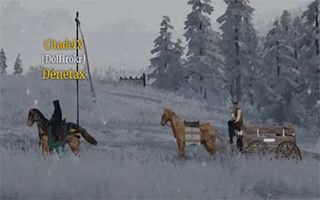
When a player harvests resources, they transport their cargo with them.
If they are not in a safe zone, you can attack them to try to steal part of their cargo.
To do this, first switch to pursuit mode by simply clicking on your target’s name, then click the 'Pursue' button.
At that moment, your target receives a visual and audio notification indicating that you are causing trouble, and they will logically try to flee.
To initiate PvP, you must catch up to them. Fortunately for you, the more loaded their wagon is, the slower it is, and the easier it is to intercept them.
Small tip: if you bring cavalry units, you will be even faster, making interception easier.
Once your target is intercepted, a battle begins and each player must choose one unit to fight.
Note that anyone can join the fight either as a defender of your target or as an attacker alongside you. To win the battle, you must capture the enemy field. Once completed, you will recover part of their cargo.
Useful tip: you can tell how loaded your target is simply by looking at their wagon skin
- No wagon: your target is loaded between 0% and 5%, giving them Fast speed (not counting units)
- A wagon loaded between 5% and 35% has a basic wagon skin (3 barrels and 1 crate) with moderate speed
- A wagon loaded between 36% and 74% remains basic but visually has around 10 crates and moves slowly
- Finally, a wagon loaded between 75% and 100% has a white horse and fabric cover; its speed is very slow
Abandoned camps, dilapidated huts, crates, wagons
Let’s continue with the third method of obtaining wagon resources: abandoned camps, dilapidated huts, crates, wagons, etc.
Their contents are random and may grant you, among other things:
- Bronze coins
- Inventory resources
- And of course small amounts of wagon resources.
You can find them at random locations on the world map.
The Auctioneer
Fourth method: obtaining resources through the auctioneer.
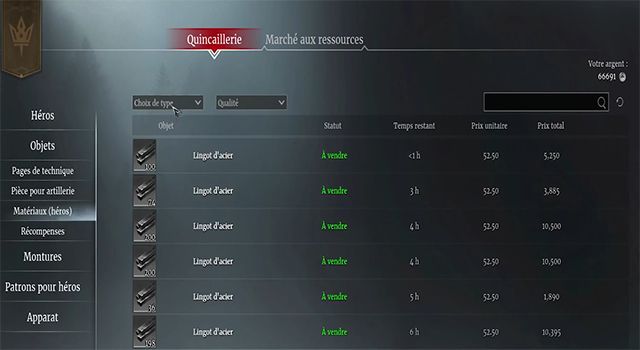
Indeed, in exchange for silver coins, you can buy wagon resources at the auction house. This method can be useful in an emergency, but it is very expensive, so I do not recommend it.
Nearby bandits
Fifth method: nearby bandits.
By fighting nearby bandits, you can obtain some rations and trophies. You will find them scattered across the world map. Be careful: bandits have 3 difficulty levels represented by the number of helmets above their heads.
- 1 helmet – Easy
- 2 helmets – Medium
- 3 helmets – Hard
In addition to this difficulty notion, there is also an aggression indicator represented by two colors:
- Yellow – bandits will not attack you if you pass near them.
- Red – they will try to intercept you.
Harvest optimization
Now that we know how to obtain wagon resources, let’s try to optimize the whole process.
Productivity
Tip number one to optimize your harvesting: productivity.
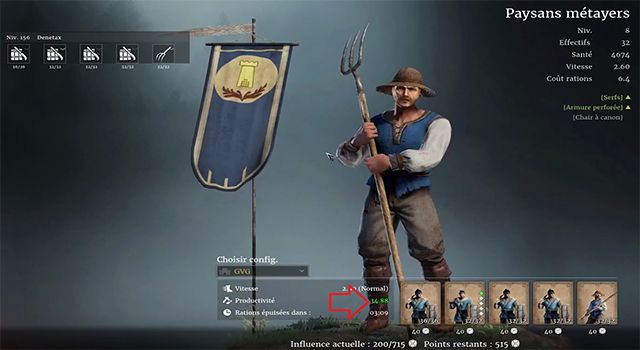
Each unit in Conqueror’s Blade has a productivity rating that indicates its performance when harvesting resources. For example, a heavily armored unit will be less efficient than a peasant unit.
A good practice when going out to harvest is to take 5 serf units in order to maximize your yield (be careful though, you will be vulnerable if intercepted).
Unit technologies
Second tip: unit technologies.
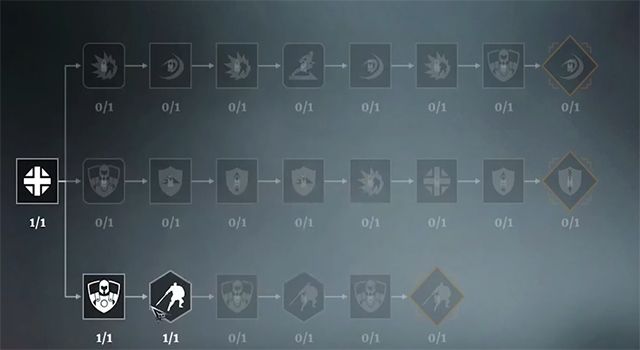
You can find a technology tree on each unit that allows you to improve its characteristics. In the case of serfs, there is a branch specialized in harvesting that will significantly increase your harvesting capabilities.
Harvesting skills
Third tip: harvesting skills.
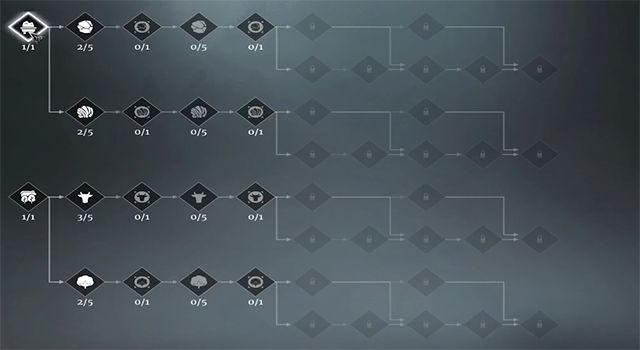
Each time you harvest resources, you gain resource experience. This experience can be used to unlock harvesting skills that can, for example, increase:
- The amount of resources collected.
- The chances of obtaining exotic resources.
There are then two choices available to you.
- Either you level up each branch, allowing you to gain a small bonus each time.
- Or you focus on a specific branch to benefit from the major bonuses.
Uses of wagon resources
It’s great to know how to obtain and optimize resource gathering, but what are they actually used for?
There are several uses.
Unit kits
The first use is, of course, unit kits, which allow you to maintain their equipment.
To do this, visit the infantry armorer to see which refined materials are required to create your kits. Once done, go to the refiner to create the necessary resources, then return to the armorer to craft the kits.
Once created, if you want to use them, press U, select the unit for which you created the kit, then click the plus icon and confirm. As long as your unit is above 50%, it will fight at full potential. Between 20% and 50%, it will deal 10% less damage and take 10% more damage. If the percentage drops below 20%, the unit cannot fight.
Artillery crafting
Second use:
artillery crafting.
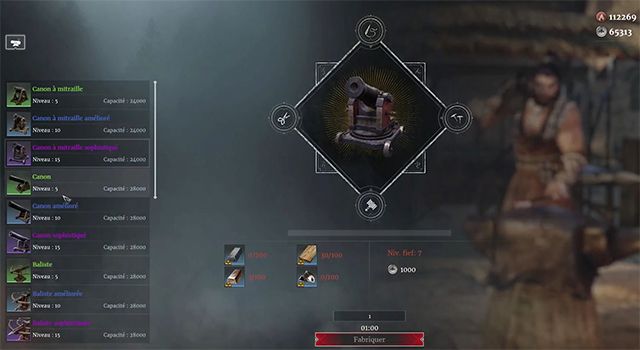
Wagon resources can also be used to craft artillery that can be used in different game modes, but are especially important in guild-versus-guild battles.
To see which resources are required, visit the artillery manufacturer. As with unit kits, refine the resources and return to the artillery manufacturer to craft your artillery.
Once crafted, if you wish to use it in battle, you must select it on the loading screen and press the G key to deploy it.
For GvG battles, you will need to transfer it from your storage to your wagon.
Once this operation is complete, if you wish, you can verify that your artillery is with you by going out into the open world, where you will see it at the back of your horse.
Fief quests
Let’s move on to the third use:
fief quests.
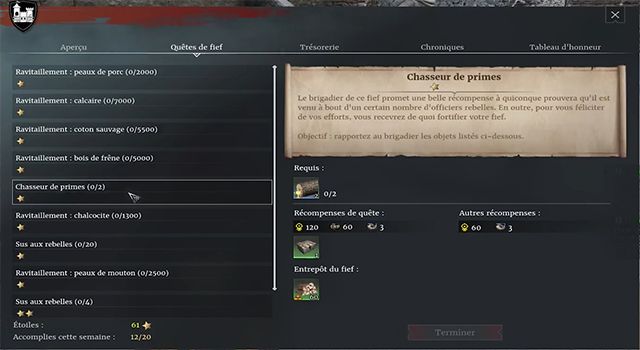
Each castle, city, and village has fief quests that involve harvesting resources or collecting trophies from bandits.
The rewards for these quests are:
- Honor points
- Reputation points
- Unit kits
- Construction materials (used to maintain and upgrade the fief level)
- House experience
Each quest has a rank that indicates its difficulty level. Naturally, the more resources a quest requires, the better the rewards.
Additional information: you are limited to 20 quests per week. Choose carefully which ones to complete.
And that concludes wagon resources. We will now move on to inventory resources.
And as before, we’ll start with the methods of obtaining them.
Methods for obtaining inventory resources
Weekly quests
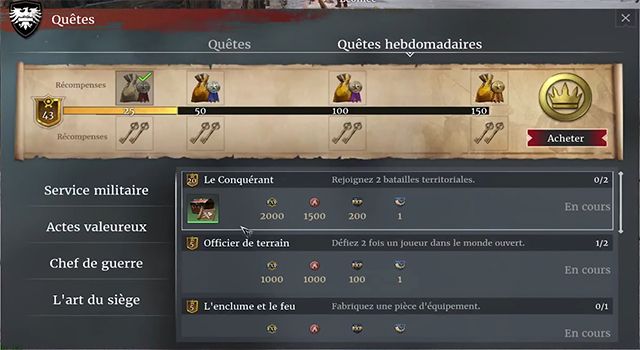
The first method: weekly quests. Some weekly quests reward resource chests that naturally contain low-quality resources.
To obtain these chests, simply complete the associated quest.
To see the requirements, press L, then go to the weekly quests tab.
Seasonal chests
Second method: seasonal chests!
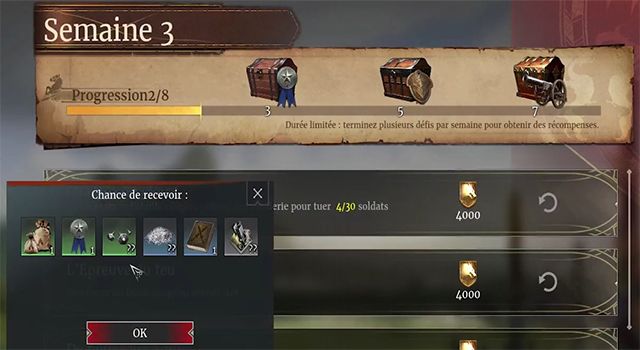
Just like weekly quests, seasonal chests allow you to obtain decent, rare, and epic-quality resources.
To see how many challenges you need to complete to earn seasonal chests, press F5, then select the desired week and review the available challenges.
PvE instances
Third method: PvE instances.
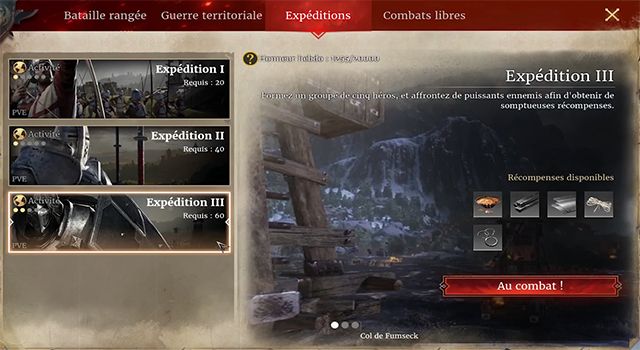
In general, PvE instances allow you to collect inventory resources. This is particularly the case for expeditions.
To launch an expedition, press J, then Expeditions, and select the expedition you want to start.
Abandoned camps, dilapidated huts, crates, wagons
Fourth method: abandoned camps, forgotten crates, and similar locations may contain inventory resources.
As mentioned in the wagon resources section, you can find them anywhere on the world map.
Recycling
Fifth method: recycling. When you recycle a piece of armor or a weapon, you obtain resources. The higher the rank of the recycled item, the higher the quality of the components you receive.
To recycle an item, go to your city’s blacksmith. Select the item(s) you want to recycle, then click recycle.
The Smuggler
Sixth method: the smuggler. Let’s say you have everything needed to craft an armor piece except for one component, and you don’t really want to start another match or head out into the open world. The smuggler can sell you components at very high prices. This is not recommended, but it can be useful in a pinch.
Note: the smuggler only sells common-quality resources.
The Auction House
Seventh method: the auction house. Yes, you can simply buy resources with silver coins at the auction house.
The Vault Room
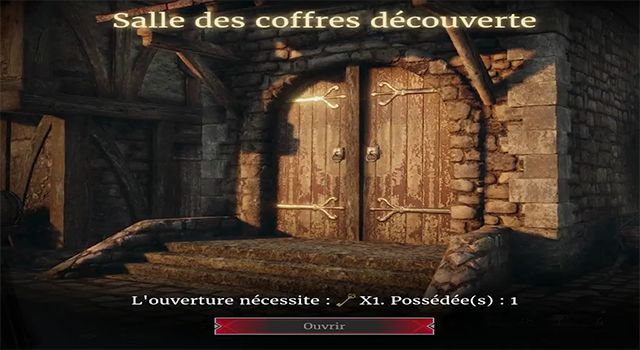
Eighth method: the Vault Room. If you have a key that allows you to open the Vault Room, you can obtain inventory resources.
Note that the Vault Room has a low chance of appearing at the end of a battle (siege, field battle, etc.), but a much higher chance of appearing after completing a bandit camp.
Uses of inventory resources
That’s a lot of ways to obtain resources, but what can you actually do with them?
Crafting armor and weapons
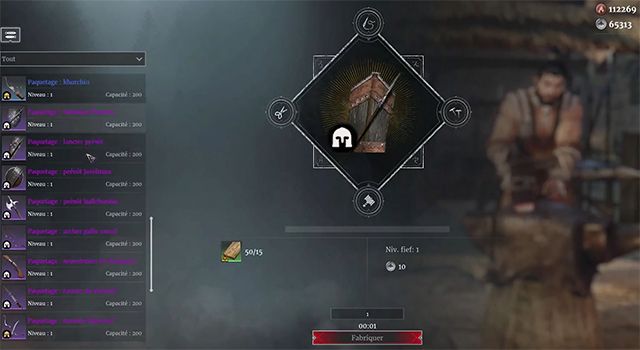
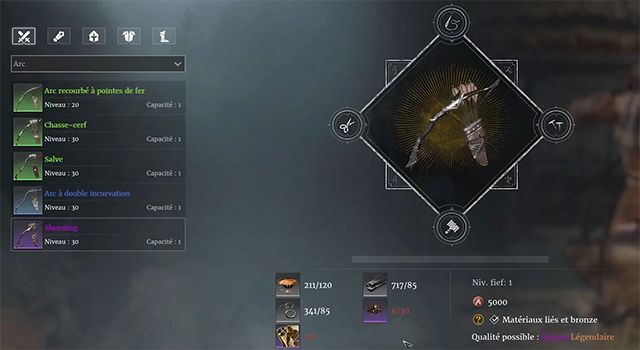
The main use is crafting armor and weapons. To do this, go to the blacksmith and select the weapon or armor you want to craft.
Horse equipment
You can also craft equipment for your horse at the blacksmith. This equipment will help it better withstand damage on the battlefield.
Reconditioning
Another useful feature is reconditioning. First of all, you should know that every piece of equipment has durability. If durability gets too low, the equipment loses effectiveness. If that happens, don’t panic—you can use reconditioning to restore durability. Note that reconditioning modifies an item’s attributes.
Bound resources
One last additional note that is not directly related to usage. You may have noticed a small chain-link icon on some inventory resources. This icon means you cannot sell this material at the auction house, and if you use it to recondition or craft an item, you will not be able to sell that item either.
This is already the end of this article. I hope you enjoyed it. Don’t forget to give a thumbs up if you liked it, and subscribe if you want to follow the channel! Remember that you can use the code
ZYX515 to gain access to some in-game benefits for new players, or
ZYL515 for players who haven’t launched the game in over a month.