Hello my zoulous, and welcome to this new article.
In this video, we are going to talk about a very strong frontline unit. I present to you the Reaper!
How to obtain Reaper
Let’s start with how to obtain them.
The Reaper are accessible through the unit tree by pressing U, then Unit Tree, then Infantry. Of course, you will need to unlock the points before the Reaper in order to access them.
Once the Reaper have been unlocked, there are several important points to cover.
Veterancies Reaper
Let’s talk about veterancies.
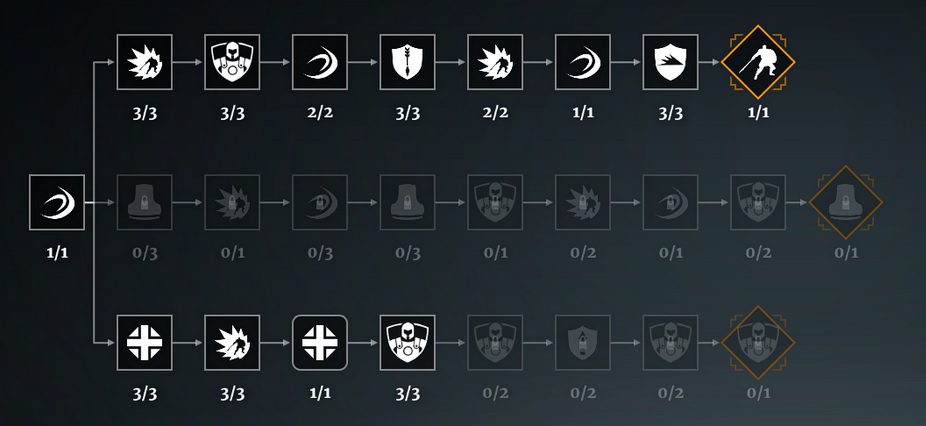
The Reaper have 3 veterancy paths.
The most common veterancy, and the one I recommend if you are not sure what to choose, is the top line all the way, then the bottom line. This veterancy mainly focuses on sword damage.
The second viable but less commonly used veterancy is the middle line followed by the bottom line. Here, you will focus more on flail damage.
You also have many other veterancy options that are more specialized or are simply variations of the first two. At first, I recommend sticking with the first veterancy to get familiar with the unit.
Doctrines Reaper
Regarding doctrines,
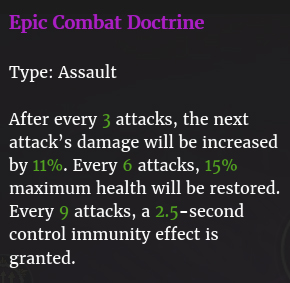
- The combat doctrine, also known as 3-6-9, is very important to use on the Reapers. It notably increases your unit’s damage, heals your unit when it lands 6 hits, and can even grant CC immunity if it reaches 9 hits.
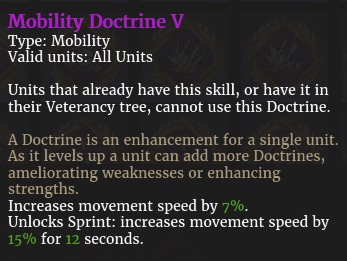
- Since the unit has rather low mobility, you may also want to add a mobility doctrine.
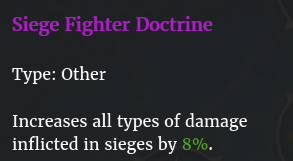
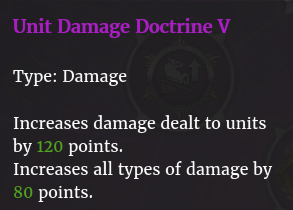
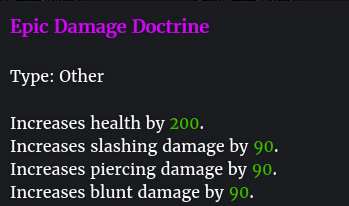
- Siege damage doctrines against units, as well as the epic damage doctrine, are also interesting to boost the Reapers’ burst damage.
- You can also add more defense to the unit, notably with the supply doctrine, which reduces damage taken by 5% and increases the unit’s health.
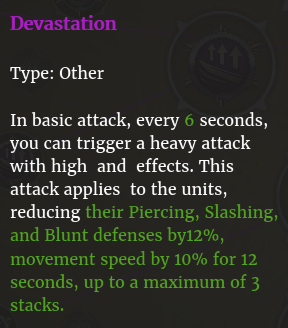
- The devastation doctrine can also be interesting if you have it available.
Role of the Reaper
First of all, the Reapers have a unique feature shared by very few units: they wield two weapons and can switch between them by pressing 5. The flail is better for blunt damage, while the sword deals slashing damage.
The most common way to use Reapers is to equip the flail first, charge toward your target, switch to the sword once in contact, and then activate the second skill, Tiger’s March.
*rixmome* But why do you charge with the flail instead of the sword if you recommend the sword-focused veterancy?!
Well, charging with the flail not only deals damage, but also reduces the resistances of the units hit and breaks their block.
This is the method you will use in most situations, but there are cases where you will need to play differently.
First situation:
Your opponent is a shield wall or has very high block values, such as Imperial Spear Guards or Palace Guards. In this case, you should use the flail, charge into them, and use skill 2 after landing an auto-attack. You should stay in flail mode, as its block-breaking value is much higher and will allow you to break shields faster.
Second situation:
You are facing braced units such as Fortebraccio or phalanxes. In this case, you should not charge directly into the unit, as it would gain a damage bonus. Instead, move close to the enemy unit using the X key, perform a flail auto-attack, then charge into contact to apply the resistance reduction, switch to the sword, perform an auto-attack, and activate skill 2.
An important detail not mentioned on skill 2: once activated, it grants CC immunity for a few seconds. This can allow you, for example, to ignore the control of Imperial Pike Guards and destroy the unit.
Formations Reaper
Let’s now go into more detail about formations.
The Reapers have 3 formations.The first is the spread formation. This formation is interesting because its wide layout allows Reapers on the edges to potentially flank and increase damage dealt. It is ideal for engaging in relatively open spaces. This is the formation you will use for most engagements.
The second is the rank formation. This formation is even wider than the first, with only two Reapers per row. I do not recommend using this formation, as it is likely that not all Reapers will reach the target due to environmental obstacles, and it reduces overall damage impact.
The third formation is the column formation. Reapers are tightly packed in rows, making this formation suitable for choke points. It can also be used to engage shield walls in a tight formation. However, be careful of nearby heroes who may completely cancel the charge.
A small but important detail: Reapers have passive abilities.
First passive: Ambidextrous Executioners. Depending on the equipped weapon, Reapers gain different bonuses—10% damage to infantry with the sword, and 30% bonus damage to shielded units. This aligns well with what we discussed earlier.
Second passive: Very Heavy Armor.
By default, Reapers reduce damage taken by 60%. Each hit the Reaper receives reduces this percentage by 2.5%, down to a minimum of 18%. An important detail: this damage reduction value is reset when using Charge or Tiger’s March. It can therefore be useful to save your charge to reset damage reduction during combat and keep your Reapers alive longer.
Another important point to watch out for: when the sword is equipped, regardless of formation, Reapers will automatically attack the nearest enemies even if they were not ordered to do so. This can sometimes lead to losing your Reapers unnecessarily. Remember to switch back to the flail or closely monitor your units.
Final important note: try to learn unit matchups as much as possible. Reapers have several counters—cavalry in general, even though in some situations Reapers can still handle themselves. On the infantry side, Reapers perform well against most melee units, with the exception of Queen’s Knights and Silahdars. Avoid 1v1 engagements against these units.
This is already the end of this article. I hope you enjoyed it. Don’t forget to give a thumbs up if you liked it, and subscribe if you want to follow the channel! Remember that you can use the code ZYX515 to gain access to some in-game benefits for new players, or ZYL515 for players who haven’t launched the game in over a month